
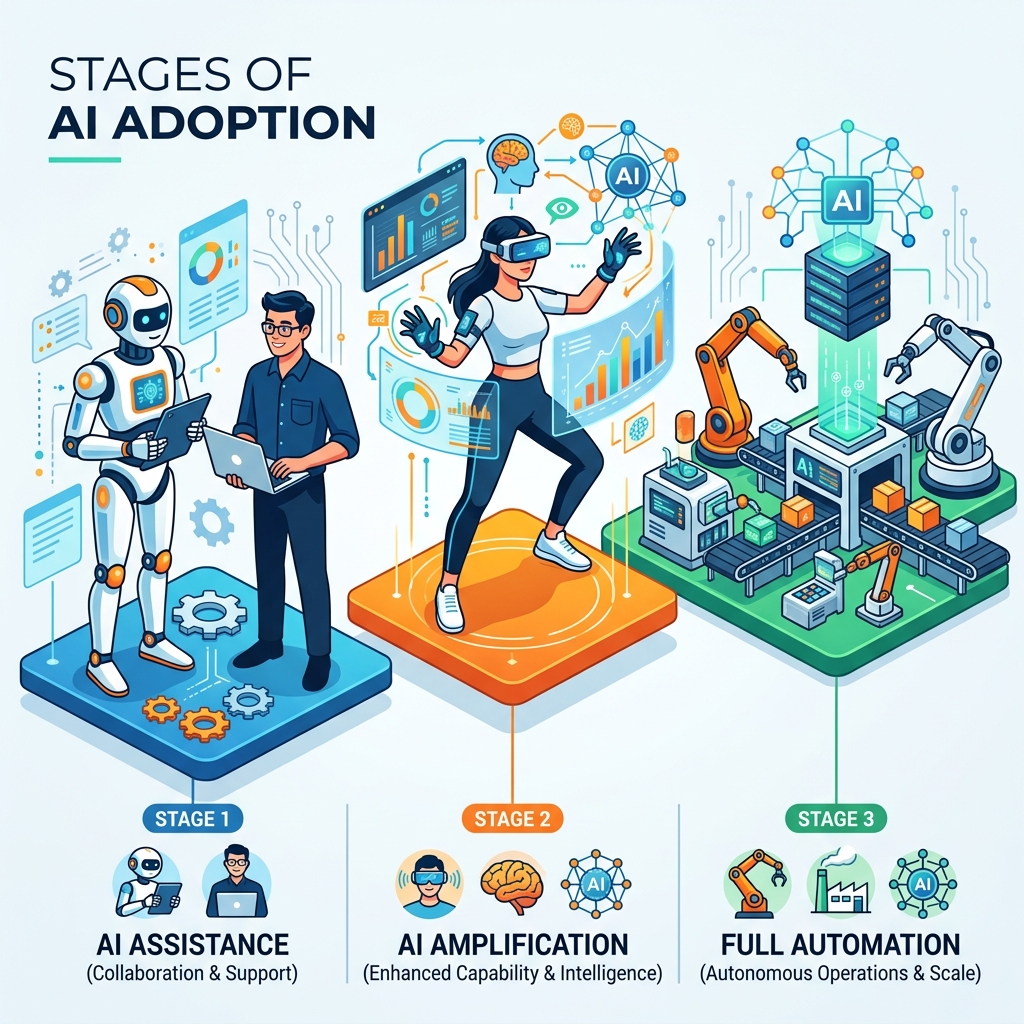
TL;DR — Throwing AI at random business processes is a recipe for wasted budget. To get a real return on investment, you need a structured strategy. The Assist-Augment-Replace (AAR) framework helps you categorize tasks based on human-in-the-loop requirements. By progressing from co-piloting (Assist) to collaboration (Augment) and finally delegation (Replace), you can deploy automation safely and measure clear ROI.
The Assist-Augment-Replace Framework
Not every task is ready for full automation. Trying to build an autonomous agent for a high-risk, unstructured task (like customer contract negotiations) is dangerous and expensive. Instead, classify your operations into three clear tiers:
[ Assist ]    ──►    [ Augment ]    ──►    [ Replace ]
(Co-pilot)          (Collaborator)         (Autonomous)
Comparing the Tiers
| Tier | Human Role | AI Role | Best Use Cases |
|---|---|---|---|
| Assist | Full Control | Drafts, simplifies, summarizes | Meeting notes, email templates, research |
| Augment | Reviewer / Sign-off | Prep work, formatting, initial draft | Proposal writing, contract reviews, reporting |
| Replace | Exception Handler | Complete end-to-end execution | Invoice chasing, lead qualification, CRM entry |
Tier 1: Assist (The Co-pilot)
In this tier, a human operator is driving. The AI acts as a reactive assistant to speed up their manual workflow. If the AI makes a mistake, it doesn’t matter because the output is never sent directly to a client or database without active human handling.
- How it works: A customer support agent uses Claude or Gemini to draft replies to a complex technical support ticket.
- Why it matters: It reduces the time-to-reply from 15 minutes to 3 minutes, but the human remains completely responsible.
Tier 2: Augment (The Collaborator)
In this tier, the AI handles the bulk of the cognitive heavy lifting, but pauses before execution to await human approval. This is the sweet spot for complex or moderately high-risk workflows.
- How it works: An automated script reads an RFP (Request for Proposal), parses the requirements, compares them against a database of previous bids, and formats a draft proposal in Google Docs. It then pings the sales manager in Slack to review and finalize the bid.
- Why it matters: It saves the manager hours of formatting and research, while retaining human-in-the-loop quality control.
Tier 3: Replace (The Autonomous Agent)
In this tier, the AI operates as an independent digital worker. It has access to APIs, databases, and communication channels. Humans only step in as exception handlers if the agent encounters an error or an input it doesn’t understand.
- How it works: An autonomous billing agent like Zira monitors past-due invoices. It emails clients, interprets response intent (e.g. “We will pay next Monday”), logs dates in the database, sends reminders, and reconciles payments against the bank ledger.
- Why it matters: It runs 24/7 with zero operational overhead, freeing up your accounting team for strategic financial planning.
FAQ
How do we decide where a task fits?
Start by auditing the risk of error. If a mistake would cost you a client or breach legal compliance, keep it in Augment mode. If it is a low-risk, high-volume task (like copying details from Facebook Ads into Zoho CRM), move it straight to Replace.
How do we graduate from Augment to Replace?
Deploy the system in “Shadow Mode” (Augment). Let the AI draft actions and present them to a human reviewer. Track the alignment between the AI’s drafts and the human’s final edits. Once the AI’s drafts require zero modifications 95% of the time, remove the manual approval gate and move it to Replace.
Note: This framework is an original operational model developed and deployed by Viswanath at VijayaTech Labs.